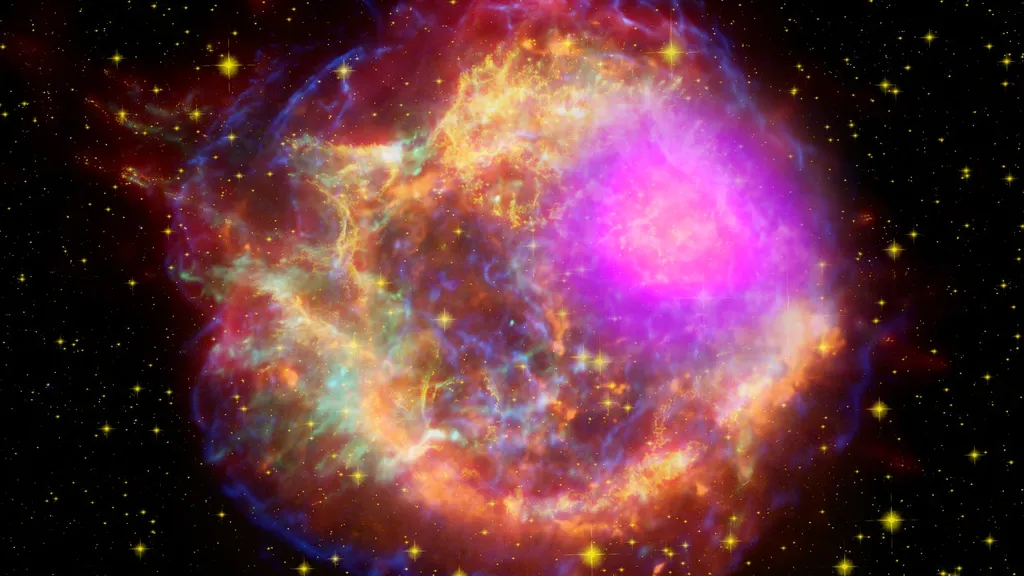
In a stunning glimpse into cosmic history, astronomers have potentially identified the most distant supernova ever observed, dating back to when the universe was a mere 730 million years old. This explosive event, captured by the James Webb Space Telescope (JWST), occurred in a faint galaxy and could rewrite our understanding of the early cosmos. As reported by Live Science, the discovery stems from JWST's ability to peer through cosmic dust and time, revealing phenomena that were previously beyond reach. Supernovae are the dramatic finales of massive stars, where gravitational collapse triggers a burst of energy that outshines entire galaxies. This particular candidate, if confirmed, exploded in an era shortly after the Big Bang, during the universe's reionization phase—a period when the first stars and galaxies began illuminating the dark void. What makes this detection remarkable is the extreme redshift involved. Redshift measures how much light from distant objects stretches toward longer wavelengths due to the universe's expansion. For this supernova, the redshift implies a light-travel time of over 13 billion years, pushing the boundaries of observable history. Technically, JWST's edge comes from its infrared-sensitive instruments, like the Near-Infrared Camera (NIRCam) and Mid-Infrared Instrument (MIRI). Unlike visible-light telescopes, JWST can detect heat signatures from ancient events that have been redshifted out of the visible spectrum. This capability allows it to observe through interstellar dust clouds that obscure shorter wavelengths, providing clearer views of nascent galaxies. Engineers designed JWST with a massive 6.5-meter segmented mirror, cooled to near-absolute zero in space, to minimize thermal noise and enhance sensitivity. These feats of engineering—deployed after a complex unfolding process in orbit—enable detections that ground-based or even Hubble telescopes couldn't achieve with the same precision. This finding matters profoundly for cosmology. Supernovae are cosmic forges, synthesizing heavy elements like iron and gold that seed future stars and planets. Spotting one so early suggests that massive stars formed and died quicker than some models predict, accelerating the universe's chemical enrichment. It could refine theories on galaxy formation, indicating that even small, faint galaxies hosted powerful stellar engines in the cosmic dawn. Moreover, confirming this as a supernova (rather than a quasar or other transient) would validate JWST's role in probing the "Epoch of Reionization," helping astronomers map how ultraviolet light from early stars cleared the fog of neutral hydrogen. Comparatively, this eclipses prior records. Hubble previously spotted supernovae from around 10-11 billion years ago, but JWST has already shattered expectations with galaxies from 300 million years post-Big Bang. This supernova candidate aligns with other JWST breakthroughs, like the unexpectedly mature early galaxies reported in 2022, challenging the Lambda-CDM model of cosmic evolution. Historically, such distant observations echo the 1990s Hubble Deep Field images, which revolutionized our view of the universe's depth, but JWST's infrared prowess takes it further, potentially unveiling a population of "Population III" stars—pristine behemoths from the universe's first generation. From an industry perspective, this discovery underscores JWST's $10 billion investment payoff, bolstering NASA's case for future missions like the Habitable Worlds Observatory or the Nancy Grace Roman Space Telescope. It fuels private sector interest too; companies like SpaceX and Blue Origin are eyeing telescope deployments in deeper space, while AI-driven data analysis from firms like Google could accelerate similar findings. Yet, challenges remain: confirming the supernova requires follow-up spectra, and JWST's limited operational lifespan (potentially 20 years) highlights the need for sustained funding in space exploration. If verified, this ancient blast isn't just a record; it's a window into the universe's turbulent youth, reminding us how far we've come in unraveling its secrets. As JWST continues its survey, expect more revelations that could upend textbooks and inspire the next wave of astronomical innovation. (Word count: 528)