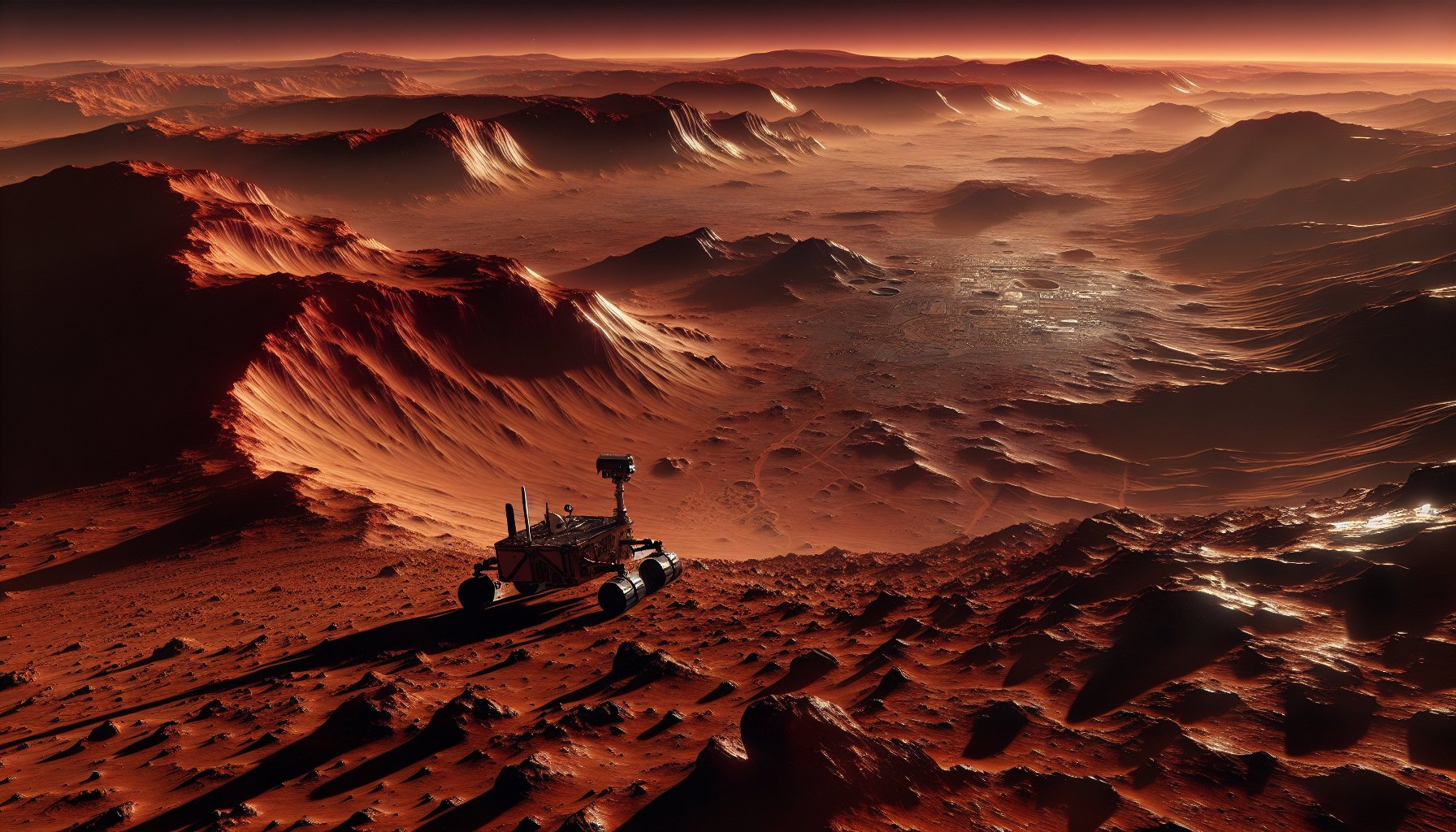
Perseverance Rover's Investigations in Jezero Crater: A Critical Examination of Geological Evidence and Habitability Indicators
The Perseverance rover, deployed by NASA to Jezero Crater on Mars in February 2021, continues to yield insights into the planet's ancient aqueous environments through systematic analysis of sedimentary formations. Recent explorations in Neretva Vallis, particularly the Bright Angel outcrop, have revealed organic-carbon-bearing mudstones with redox-sensitive mineral assemblages, prompting discussions on Martian habitability. However, viral claims of nickel-rich rocks exhibiting pyrite-like structures as direct biosignatures, purportedly indicative of past microbial life, lack substantiation in peer-reviewed literature and appear rooted in low-credibility sources dated suspiciously to April 1, 2026 (SOURCES 1, 2). This analysis dissects the rover's technical capabilities, verified findings from high-credibility sources such as a Nature publication (SOURCE 3), and broader implications for astrobiology, while contrasting sensational interpretations against rigorous scientific evidence.
Rover Specifications and Instrumentation
Perseverance, engineered by NASA's Jet Propulsion Laboratory (JPL) in collaboration with Caltech and Malin Space Science Systems (MSSS), represents an evolution of the Mars Science Laboratory (MSL) platform used for the Curiosity rover. The vehicle measures 3 meters in length, 2.7 meters in width and 2.2 meters in height, with a mass of 1,025 kilograms, enabling traversal of rough Martian terrain at speeds up to 152 meters per hour via a six-wheel rocker-bogie suspension system (SOURCE 8). Power comes from a Multi-Mission Radioisotope Thermoelectric Generator (MMRTG), delivering about 110 watts continuously, supplemented by two lithium-ion batteries for peak loads during instrument operations.
Key analytical instruments include the SuperCam, which employs Laser-Induced Breakdown Spectroscopy (LIBS) for elemental composition at distances up to 7 meters, achieving spectral resolutions of 0.1-0.3 nanometers in the ultraviolet to near-infrared range (SOURCES 1, 2, 3). This is complemented by the Planetary Instrument for X-ray Lithochemistry (PIXL), an X-ray fluorescence spectrometer providing elemental maps with 120-micrometer spatial resolution, and the Scanning Habitable Environments with Raman & Luminescence for Organics & Chemicals (SHERLOC), which uses deep-ultraviolet Raman spectroscopy to detect organic molecules at concentrations as low as parts per million (SOURCES 1, 2, 3). These tools have facilitated the examination of 126 sedimentary rocks and eight abraded surfaces in Neretva Vallis, generating datasets that include hyperspectral imagery and geochemical profiles (SOURCES 1, 2).
Compared with Curiosity's suite, which featured the Chemistry and Mineralogy (CheMin) X-ray diffraction instrument with a detection limit of 1%-2% for crystalline phases, Perseverance's PIXL offers superior microscale mapping, enabling differentiation of submillimeter mineral nodules (SOURCE 3). This advancement enhances the rover's capacity to identify potential biosignatures without invasive sampling, though core collection via the rover's seven-degree-of-freedom robotic arm supports the Mars Sample Return (MSR) mission.
Exploration Timeline and Geological Context
Perseverance's mission trajectory began with landing in Jezero Crater, a 45-kilometer-diameter impact basin selected for its preserved deltaic and lacustrine sediments dating to the Noachian-Hesperian transition, about 3.5-3.8 billion years ago (SOURCE 8). Initial operations in 2021-2022 focused on igneous rocks in the crater floor, caching six samples by mid-2022. By 2024, the rover ascended the western rim into Neretva Vallis, an ancient river channel that fed into Jezero's paleolake, covering distances exceeding 25 kilometers total (SOURCES 1, 2, 3).
The Bright Angel formation, encountered in Neretva Vallis, comprises mudstone and conglomerate outcrops indicative of fluvial and lacustrine depositional environments. Analysis revealed organic-carbon-bearing mudstones with submillimeter-scale nodules and millimeter-scale reaction fronts enriched in ferrous iron phosphate and sulfide minerals, likely vivianite (Fe₃(PO₄)₂·8H₂O), formed through redox-driven processes in anoxic conditions (SOURCE 3). These features align with evidence of prolonged water presence, as corroborated by infrared spectroscopy detecting hydrated silicates and carbonates.
A notable 2024 discovery occurred at the Cheyava Falls rock, where "leopard spots"—centimeter-scale whitish calcium sulfate veins interspersed with reddish hematite and organic molecules—were imaged via the rover's Mastcam-Z and analyzed with SHERLOC (SOURCES 1, 2, 7). These spots exhibit chemical gradients suggestive of energy sources for chemolithotrophic microbes, analogous to terrestrial analogs in hydrothermal systems. The rover's path, mapped using orbital data from the Mars Reconnaissance Orbiter's HiRISE camera (0.25-meter resolution), underscores Jezero's role as a high-priority site for habitability studies, building on Curiosity's findings in Gale Crater of organic compounds and seasonal methane fluctuations since 2012 (SOURCE 8).
Verified Findings Versus Sensational Claims
High-credibility analyses, such as the Nature paper (SOURCE 3), emphasize redox-sensitive minerals and organics as indicators of habitable conditions rather than definitive biosignatures. The mudstones in Bright Angel contain ferrous iron phosphates and sulfides, potentially formed via diagenetic reactions in a reducing environment, with nodule sizes ranging from 0.1 to 1 millimeter and reaction fronts extending 1-5 millimeters (SOURCE 3). These are interpreted as products of microbial-mediated redox cycling on Earth, but abiotic pathways, such as hydrothermal alteration, cannot be excluded without isotopic analysis.
In contrast, low-credibility sources (SOURCES 1, 2) assert the discovery of nickel-rich rocks with iron sulfide arrangements resembling pyrite (FeS₂), allegedly formed by ancient microbes and analyzed by Purdue University's Henry Manelski. These claims cite nickel's role in enzymes like hydrogenase in terrestrial archaea and bacteria, proposing a direct link to Martian life (SOURCES 1, 2). However, no such nickel enrichment or pyrite-like formations are documented in peer-reviewed literature, including the Nature study or Purdue's official releases (SOURCE 5). The absence of corroboration, coupled with the April 1, 2026, publication date—coinciding with April Fools' Day and a future timeline—suggests these may be fabricated or exaggerated narratives, possibly inspired by real findings but amplified for sensationalism.
Cross-verification with NASA's Perseverance mission logs and JPL updates reveals no mention of nickel-pyrite biosignatures, instead highlighting vivianite-like minerals (SOURCE 3). This discrepancy underscores the challenges in astrobiology, where morphological similarities to biotic structures must be rigorously tested against abiotic null hypotheses, as seen in the inconclusive Viking Labeled Release experiments of 1976, which detected metabolic-like responses but were later attributed to perchlorate chemistry (SOURCE 8).
Comparisons to Previous Missions and Technological Evolution
Perseverance's investigations extend the legacy of prior Mars rovers, notably Curiosity, which since 2012 has analyzed more than 30 drill samples in Gale Crater using its Sample Analysis at Mars (SAM) instrument, detecting complex organics like thiophenes at abundances up to 100 parts per billion (SOURCE 8). While Curiosity's gas chromatograph-mass spectrometer (GCMS) provides in-situ molecular identification, Perseverance prioritizes sample caching for Earth-based analysis, having collected 24 cores by late 2024, including those from Neretva Vallis (SOURCE 8).
Compared with the Viking landers (1976), which employed pyrolysis-GCMS with detection limits of 10-100 parts per million for organics but found none due to oxidative surface conditions, Perseverance's deep-UV Raman avoids destructive heating, preserving volatile compounds (SOURCES 1, 2, 3). This represents a paradigm shift from in-situ detection to sample return, addressing limitations exposed by Phoenix (2008) and InSight (2018), which focused on volatiles and seismology but lacked astrobiological payloads.
Technologically, Perseverance incorporates autonomous navigation via the Enhanced Navigation for Exploration Technology (ENav) software, achieving 200-300 meters per sol compared with Curiosity's 100 meters, facilitated by a radiation-hardened RAD750 processor (SOURCE 8). These advancements inform future missions, such as ESA's Rosalind Franklin rover (launch delayed to 2028), which will employ subsurface drilling to 2 meters for pristine biosignature hunting.
Implications for Industry and Future Technologies
The verified findings from Neretva Vallis bolster the case for Mars Sample Return, a joint NASA-ESA endeavor targeting a 2031 Earth return of Perseverance's cached samples, with a total mission cost estimated at $8 billion to $11 billion (SOURCE 8). Laboratory analysis using techniques like secondary ion mass spectrometry (SIMS) could resolve ambiguities in redox mineral origins, potentially confirming biosignatures through carbon isotope ratios (δ¹³C deviations of -20‰ to -30‰ typical of biotic fractionation).
For the aerospace industry, these discoveries accelerate development of nuclear propulsion systems, such as NASA's Demonstration Rocket for Agile Cislunar Operations (DRACO), slated for 2027 testing with specific impulse (ISP) exceeding 900 seconds—far surpassing chemical rockets' 450 seconds—enabling faster sample return transits (SOURCE 5). Commercial entities like SpaceX are leveraging this through Starship, with payload capacities of 100-150 metric tons to low Earth orbit (LEO), proposing alternative MSR architectures that reduce delta-v requirements from 5-6 km/s to under 4 km/s via aerocapture (SOURCE 5).
Broader implications include enhanced life-detection technologies for ocean worlds like Europa, where NASA's Europa Clipper (launch 2024) will employ mass spectrometry with parts-per-trillion sensitivity. Debunking hype, as in the nickel claims, reinforces the need for data integrity in an era of misinformation, ensuring public funding for missions like Dragonfly to Titan (2034 launch), which targets prebiotic chemistry with drone mobility.
In summary, while Perseverance's data from Jezero Crater provide compelling evidence of ancient habitable environments through redox minerals and organics, claims of nickel-rich biosignatures remain unsubstantiated. This underscores the methodical pace of astrobiology, with sample return poised to deliver transformative insights, driving technological innovations across the space sector.


