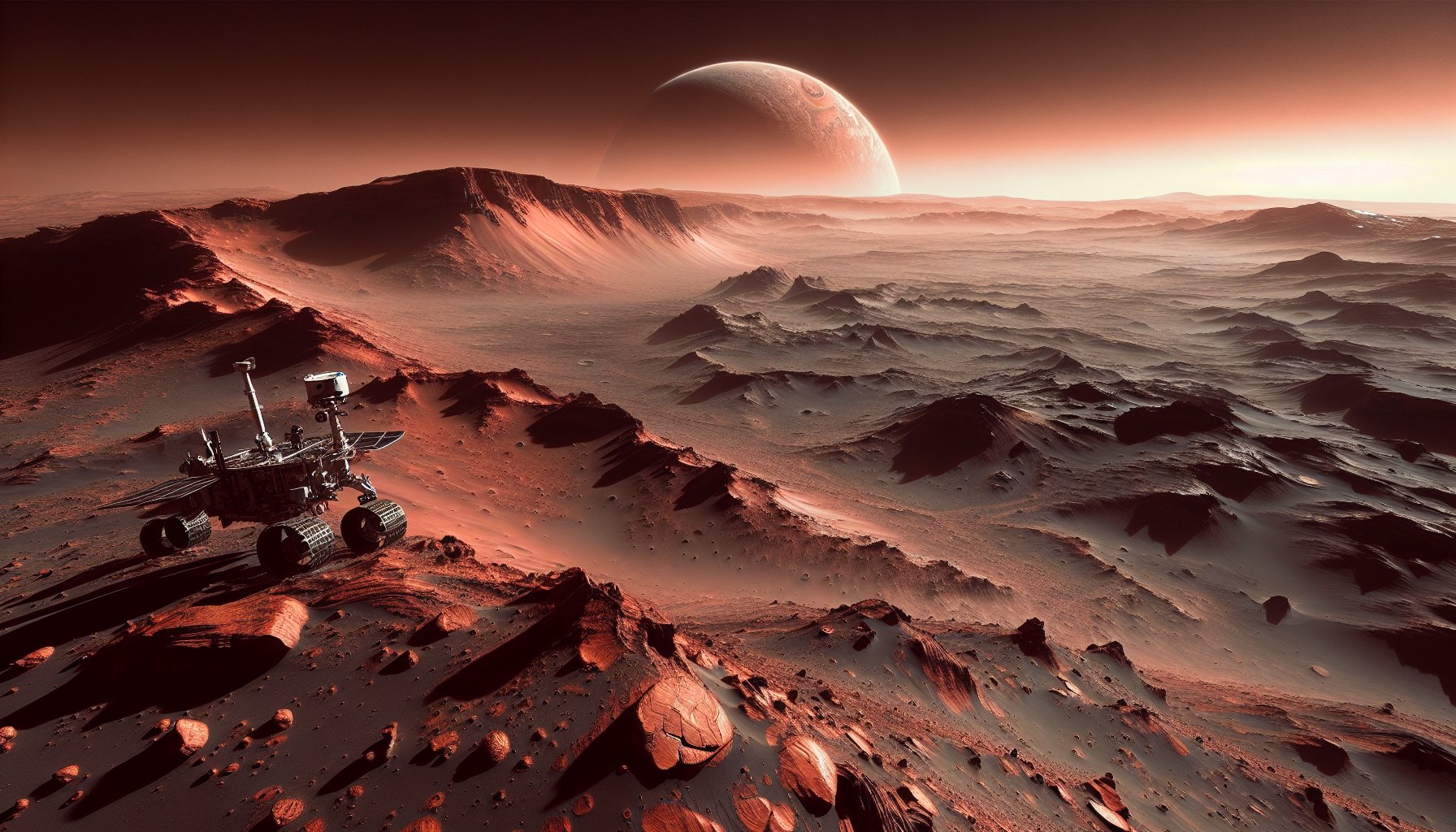
NASA’s Perseverance Rover Completes First AI-Planned Drives on Mars
PASADENA, Calif. (AP) — NASA’s Perseverance rover completed the first drives on Mars planned entirely by artificial intelligence, officials said. The drives occurred Dec. 8, 2025, and Dec. 10, 2025, along the rim of Jezero Crater. The rover covered 689 feet on the first drive and 807 feet on the second, according to the Jet Propulsion Laboratory.
The achievement marks a step toward greater autonomy for Mars exploration, NASA officials said. JPL engineers developed the AI system to analyze orbital imagery and generate safe paths without human input. The system used data from the HiRISE camera on the Mars Reconnaissance Orbiter and digital elevation models to detect hazards such as boulders and sand ripples.
JPL verified the AI-generated commands through a digital twin, a virtual replica of the rover, officials said. The simulation checked more than 500,000 telemetry variables for compatibility with the rover’s flight software, ensuring the paths aligned with operational constraints before upload.
The drives took place on Martian sols 1707 and 1709, each lasting more than two hours as the rover navigated crater-rim terrain. JPL announced the milestone Jan. 30, 2026, in a press release.
Vandi Verma, a space roboticist on the Perseverance team at JPL, described the technology’s potential. “The fundamental elements of generative AI are showing a lot of promise in streamlining the pillars of autonomous navigation for off-planet driving: perception (seeing the rocks and ripples), localization (knowing where we are), and planning and control (deciding and executing the safest path),” Verma said in the announcement. “We are moving towards a day where generative AI and other smart tools will help our surface rovers handle kilometer-scale drives while minimizing operator workload, and flag interesting surface features.”
The AI system builds on existing navigation tools like AutoNav, which Perseverance has used since landing, officials noted. Unlike previous systems that required human planners to plot routes, this generative AI handled the entire planning process. It produced waypoint-based paths from high-resolution imagery, reconstructing 3D models at intervals of about 0.1 meters.
Matt Wallace, manager of JPL’s Exploration Systems Office, highlighted broader applications. “Imagine intelligent systems not only on the ground at Earth, but also in edge applications in our rovers, helicopters, drones, and other surface elements trained with the collective wisdom of our NASA engineers, scientists, and astronauts,” Wallace said in the JPL release. “That is the game-changing technology we need.”
Perseverance landed in Jezero Crater on Feb. 18, 2021, after launching July 30, 2020. The rover’s first drive, on March 4, 2021, covered 21.3 feet and relied on human planning, NASA records show. By 2025, the mission had operated for about five Earth years, focusing on signs of ancient life and sample collection.
This AI milestone enables longer drives by reducing the impact of communication delays, which average 20 minutes one-way between Earth and Mars, officials explained. It supports kilometer-scale traverses, compared to hundreds of meters in earlier drives. Such autonomy aids the Mars Sample Return mission, where Perseverance collects samples for eventual Earth return.
The technology analyzes rover images to flag science targets, enhancing sample selection, according to JPL. Onboard navcams and hazcams provided data for post-drive reconstructions, confirming the AI paths avoided identified hazards.
NASA views this as part of a trend toward intelligent systems in space exploration. The agency has tested similar autonomy on the Ingenuity helicopter, which accompanied Perseverance. Future missions, including lunar rovers for the Artemis program, may incorporate edge AI trained on NASA data, officials said.
No prior drives on Mars used fully AI-planned routes, JPL confirmed. The drives occurred without reported issues, based on telemetry data reviewed at JPL. NASA plans to expand AI use for multi-rover operations, reducing workload for Earth-based teams. This shift prepares for human exploration by minimizing real-time oversight needs.
Perseverance continues its traverse along Jezero Crater’s rim, collecting data on geological features. The mission has cached multiple samples since landing, advancing goals for astrobiology research. JPL manages rover operations, with NASA overseeing the overall Mars 2020 mission.
Officials did not specify the exact AI model used, citing proprietary details. Success metrics, such as hazard avoidance rates compared to human plans, remain under evaluation, according to the announcement. Post-drive analysis includes science data from flagged features, though details were not released.
This breakthrough aligns with NASA’s push for autonomous technologies in extreme environments. It draws from data collected over the rover’s operational history, informing future designs. The Mars Reconnaissance Orbiter provided essential orbital support, delivering imagery for AI processing.
JPL released summaries of the drives, including distances and durations, in online updates. The agency encourages public access to mission data through its websites. Further AI-planned drives are expected as the technology matures.


